
Colorado Sex Offender Checks
The Colorado Convicted Sex Offender Search is the official public gateway maintained by the Colorado Bureau of Investigation. CBI manages the central registry under C.R.S. §16-22-110. Police departments and county sheriffs handle registration in the field, then send data to CBI and the Colorado Crime Information Center. The state interface updates available website records hourly. Even so, CBI does not guarantee that an address, map point, or profile is complete or current.
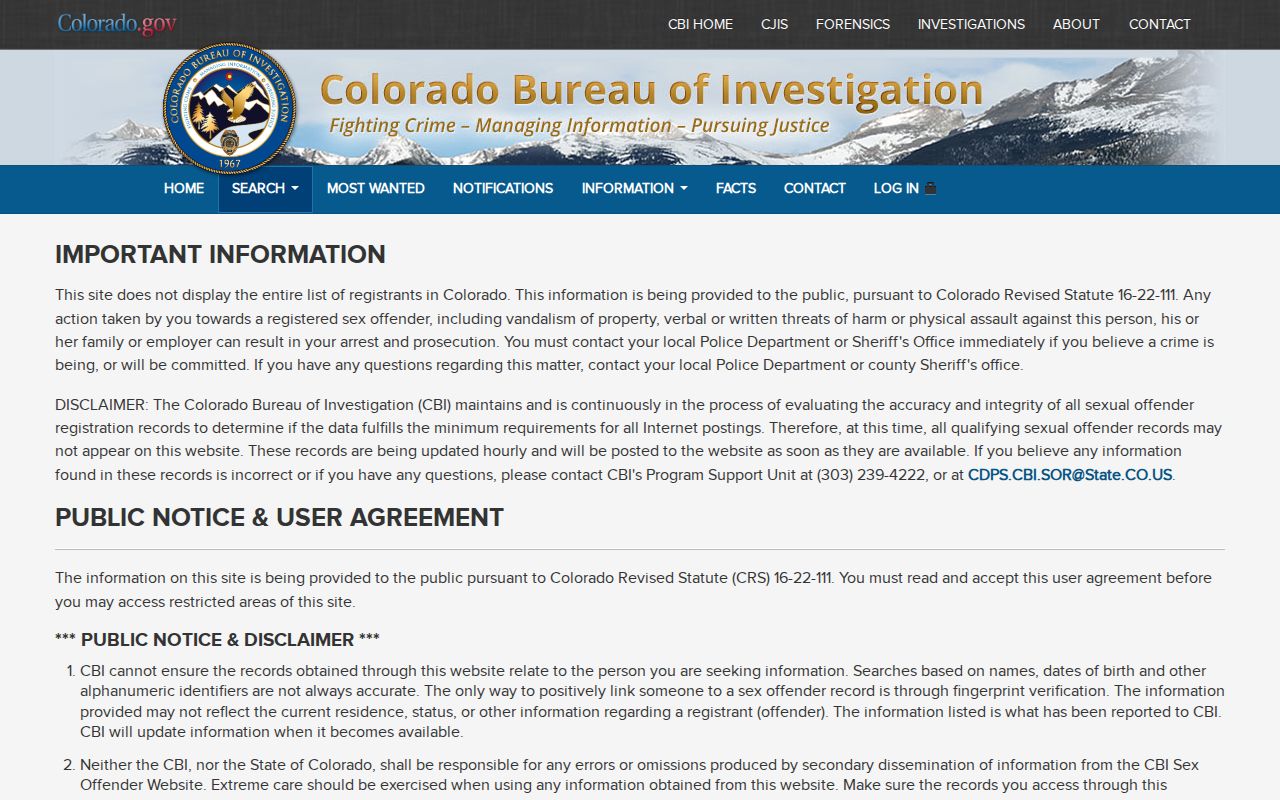
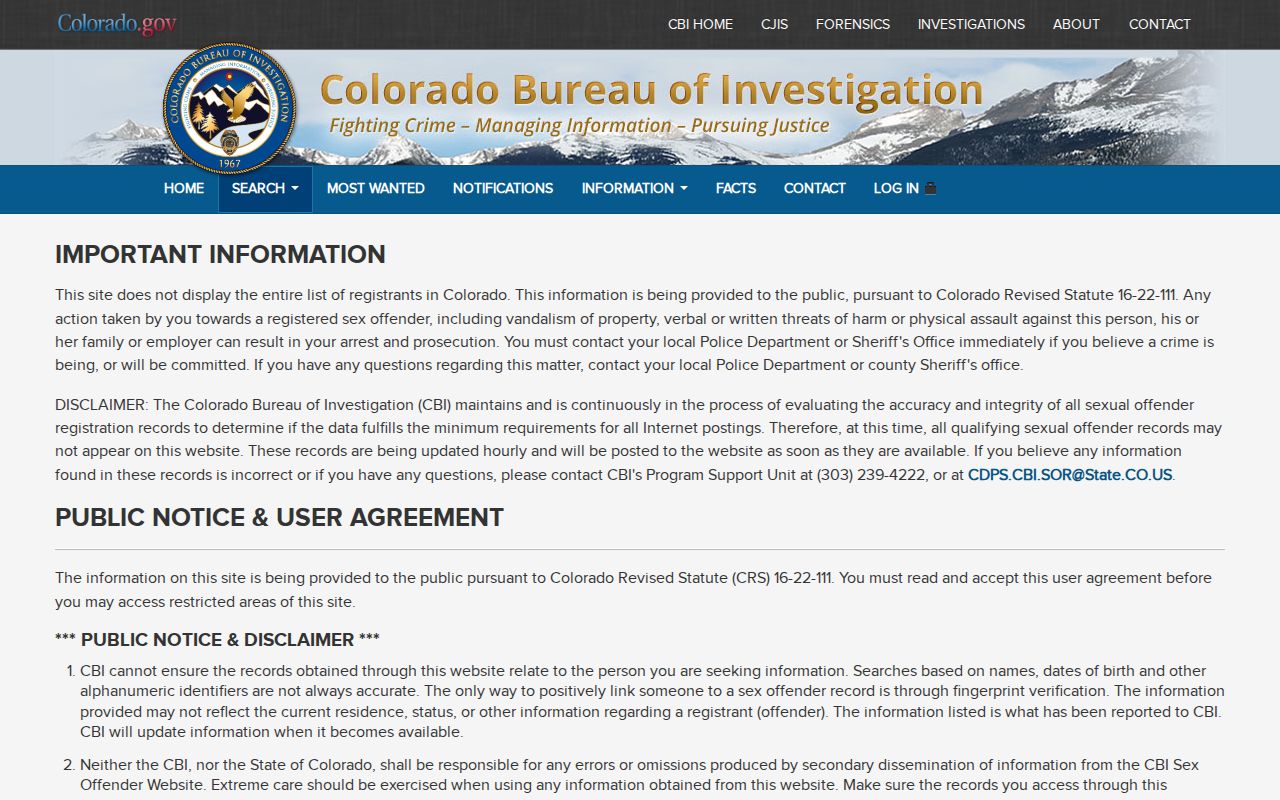
The official Colorado registry gateway shows the agreement that comes before every Colorado sex offender search.
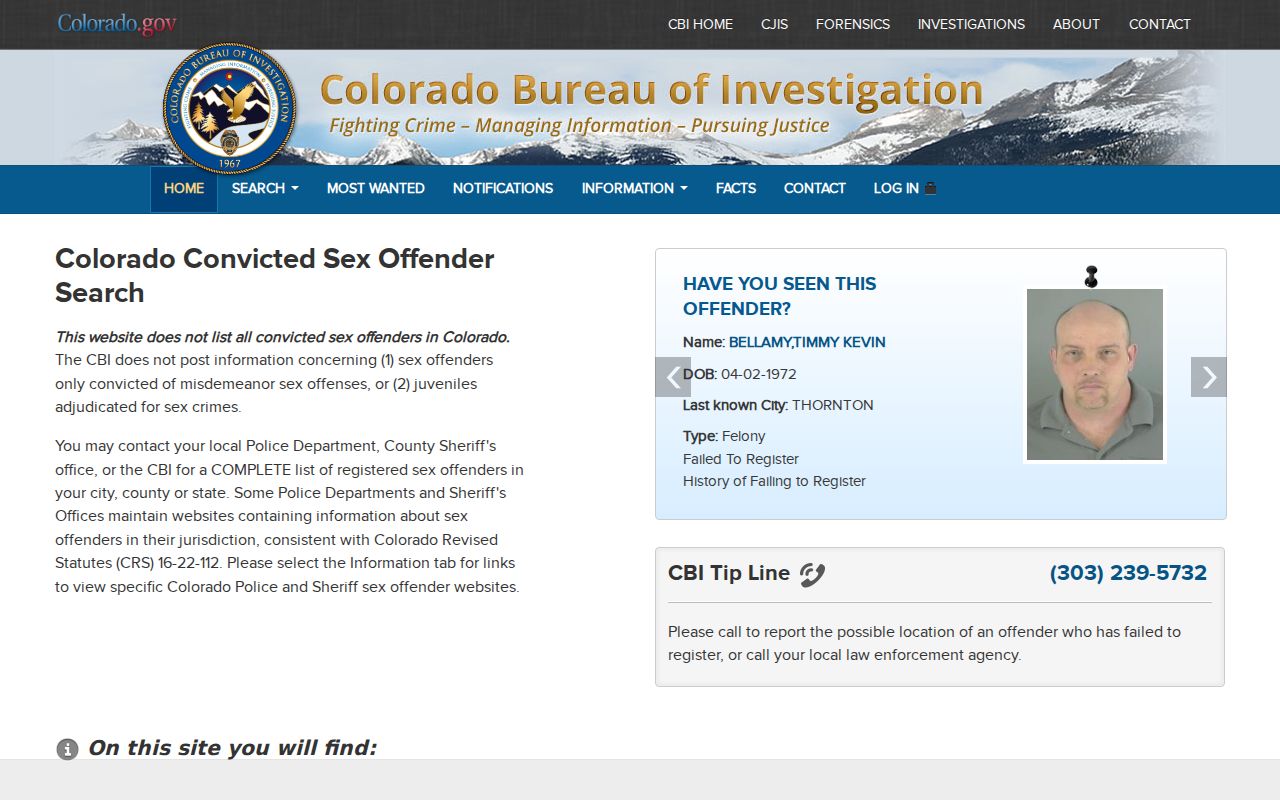
That warning matters because the public list omits juvenile-only duties, adult misdemeanor-only categories, records awaiting an Internet-posting decision, and information not yet sent by a local agency. A blank result is not proof that no registration duty exists. CBI also says a name and birth-date match is not positive identification. Fingerprint comparison is the reliable identity method.
Colorado County Registry Partnership
Colorado divides registry work between CBI and local law enforcement. A person inside municipal limits generally registers with the police department. Outside those limits, the county sheriff is the usual registration office. If a municipality has no qualifying agency, the sheriff receives the registration. Each jurisdiction of residence must receive notice, so a person may have more than one registered Colorado location.
This local layer is also the fallback when the state website is incomplete. Local agencies may release adult information that is not published in the statewide search, including some qualifying misdemeanor records. Use the Colorado county directory to identify the relevant local records route. Confirm the city or unincorporated area before contacting an office. Mailing-city names do not always match law-enforcement boundaries.
Registration flow: Local Police or Sheriff › Identity and Address Verification › CBI Registry › Publicly Releasable State Profile
Note: Local verification can be more current than a copied or republished registry result.
Colorado Registry Search Steps
The advanced Colorado registry form requires acceptance of the Public Notice and User Agreement. It is free, needs no account, and uses reCAPTCHA. At least one core field must be supplied. Search broadly first, especially when location is the main concern. Then narrow the result and inspect the profile before drawing a conclusion.
- Accept the agreement and open the advanced search.
- Enter a last name, first name, city, ZIP, or county. Add aliases for a known person.
- Review the result, photograph, physical details, date reported, county, designation, and conviction table.
- Verify any material concern with the local registration agency or CBI support.
The official advanced-search form displays the exact controls available to a public user.
The form calls its dropdown “Conviction Level,” but its values are overlapping Colorado posting categories. They are not a simple federal Tier I, II, or III scale.
| Field Label | Type | Required | Notes |
|---|---|---|---|
| Last or First Name | Text | One core field | Up to 30 characters; aliases may be included |
| City or ZIP | Text | One core field | ZIP accepts up to five characters |
| County | Dropdown | One core field | Any or one of Colorado's 64 counties |
| Conviction Level | Dropdown | No | SVP, Failure to Register, Multiple, or Felony |
| Map Radius | Map/dropdown | No | Address proximity options are 1, 3, 5, or 10 miles |
| ZIP Alerts | Account signup | No | Weekly email when registry information changes |
Colorado Registry Maps Need Context
The Colorado map search has City, Address, County, and ZIP tabs. Address searches can use a one-, three-, five-, or ten-mile radius. Map symbols distinguish felony conviction, sexually violent predator, multiple offender, and failure-to-register designations. A purple star means several profiles share a plotted location, so the map must be enlarged before reading it.
The official Colorado registry map shows these search tabs and map controls.
A map point reflects reported data and the system's best geocoding. It does not prove that a person is at that exact point now. Start with a county when a city name may cross city and unincorporated boundaries. Use the list or name result to confirm the mapped profile, then check the Date Reported field and the responsible local agency.
What a Colorado Profile Lists
A Colorado registry profile is focused on registration, not every criminal event. It can show the registered name, aliases, photograph, physical description, posted address, report date, county, body marks, public designation, and qualifying conviction data. It may also offer Print Copy and Add To Watches controls. The conviction table lists an offense description, statute, and conviction date.
| Name & Aliases | Registered identity plus an expandable alias table |
|---|---|
| Photo & Description | Photograph, sex, race, birth date, height, weight, hair, eyes, scars, marks, and tattoos when posted |
| Reported Location | Street, city, ZIP, county, and the date the data was reported |
| Conviction | Only convictions that require registration, not a full Colorado rap sheet |
| Designation | Colorado posting category such as SVP, Multiple, Felony, or failure-related status |
| Not Shown | Victim identity, a general risk score, registry end date, full custody history, and a universal compliance label |
A registry notation and a court file answer different questions. For the judgment, plea, complete counts, and sentence, use the court record in the filing county. For current custody, use the correct county jail, CDOC, or federal system.
Colorado Registry Alerts and Notice
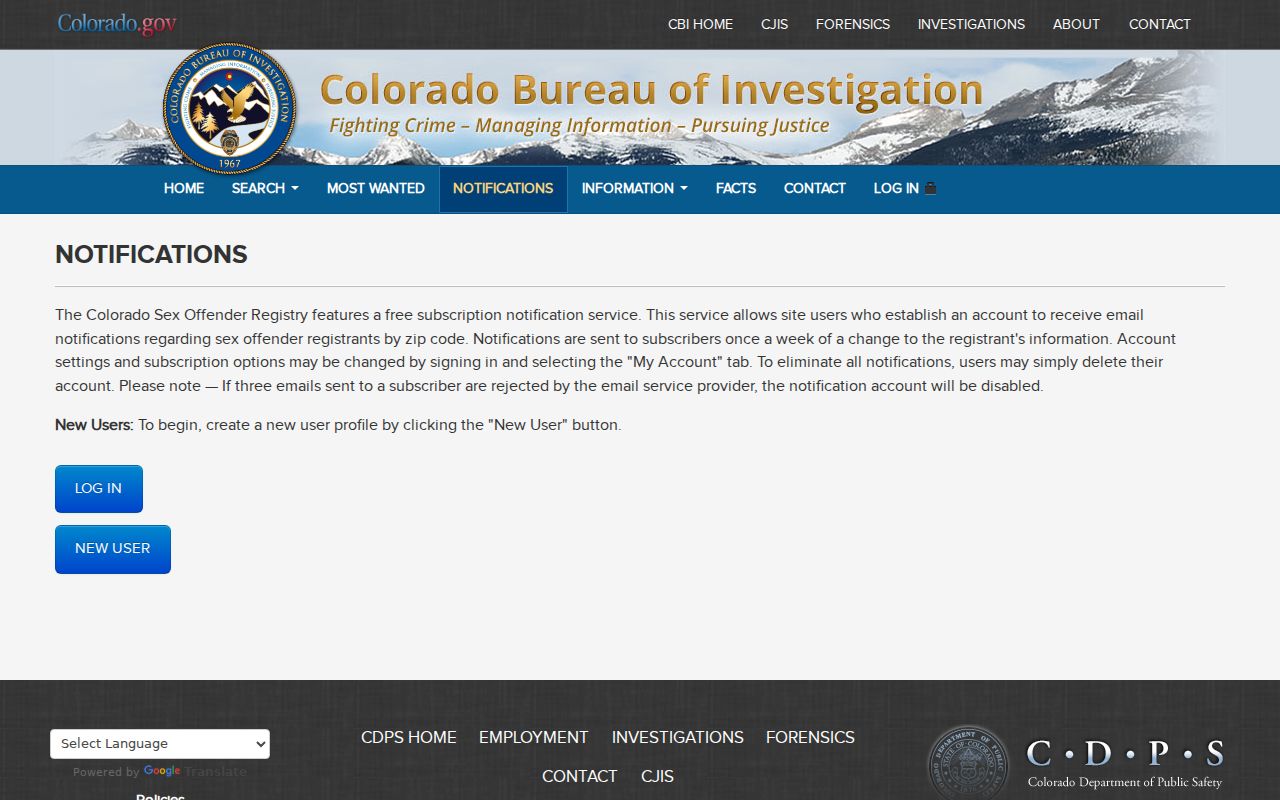
Colorado provides free ZIP notifications and individual profile watches. A ZIP subscriber receives a weekly email when registry information changes in the chosen ZIP. The account form asks for first and last name, email confirmation, and reCAPTCHA. Profile watches follow changes to one record. These tools monitor registry updates; they are not real-time alerts about a new crime or a person's movement.
The CBI notification page presents the official subscription route.
Active community notification is narrower. Colorado reserves mandatory active notice for sexually violent predators. A local agency may use a meeting or targeted electronic notice for the population at risk, with education designed to reduce vigilantism. Colorado does not require a direct notice to every home or school for every registrant.
Colorado Registry Levels and Requirements
Colorado's public designations overlap, and registration duration depends on the conviction and statutory status. Most registrants report annually around their birthday. Sexually violent predators and people convicted of specified offenses report every three months for life. A person without a fixed residence reports more often. A waiting period may permit a court petition, but it does not automatically end registration.
| Colorado Status | Duration or Relief | Verification Frequency |
|---|---|---|
| Sexually Violent Predator | Natural life; no ordinary §16-22-113 relief | Every three months |
| Specified lifetime felony | Natural life; ordinarily ineligible for relief | Every three months |
| Other class 1–3 felony | Petition may be possible after 20 years from final release | Annual unless another status controls |
| Other class 4–6 felony | Petition may be possible after 10 years | Annual unless another status controls |
| Other qualifying misdemeanor | Petition may be possible after 5 years | Annual unless another status controls |
Eligibility also depends on sentence completion, later convictions, and a court finding about future unlawful sexual behavior. Relief orders must reach CBI and each local registration agency. C.R.S. §§16-22-108 and 16-22-113 contain the controlling duties and petition rules.
A local agency may charge up to $75 for initial registration and $25 for an annual or quarterly registration. Required update reports under §16-22-108(3) carry no charge. Indigency relief may apply, and inability to pay cannot defeat timely registration.
Colorado Residence Rules Explained
Colorado has no general statewide distance buffer from schools, parks, or child-care facilities, according to CBI's official sexually violent predator material. Supervision terms and municipal ordinances can still restrict an address. Check the local jurisdiction before treating a map circle as a legal boundary.
Temporary residence can trigger registration after more than 14 consecutive business days, more than 30 total days in a year, or enrollment at a Colorado school. A registrant usually has five business days to report a new, added, or ended residence and certain name, education, or online identity changes. Current photographs and fingerprints are collected during required registration events.
Location is not a risk score. Colorado's map shows reported registration data. It does not rate present danger or confirm current presence at a coordinate.
Colorado Registry and NSOPW
Colorado's registry is the source for Colorado public data. The U.S. Department of Justice's National Sex Offender Public Website combines participating state, territorial, and tribal registries. NSOPW is useful when a move, border area, tribal land, or unknown state is part of the question. It can search by name, county, city, several ZIP codes, state, or nationwide.
The national search interface illustrates how Colorado records can be checked alongside other jurisdictions.
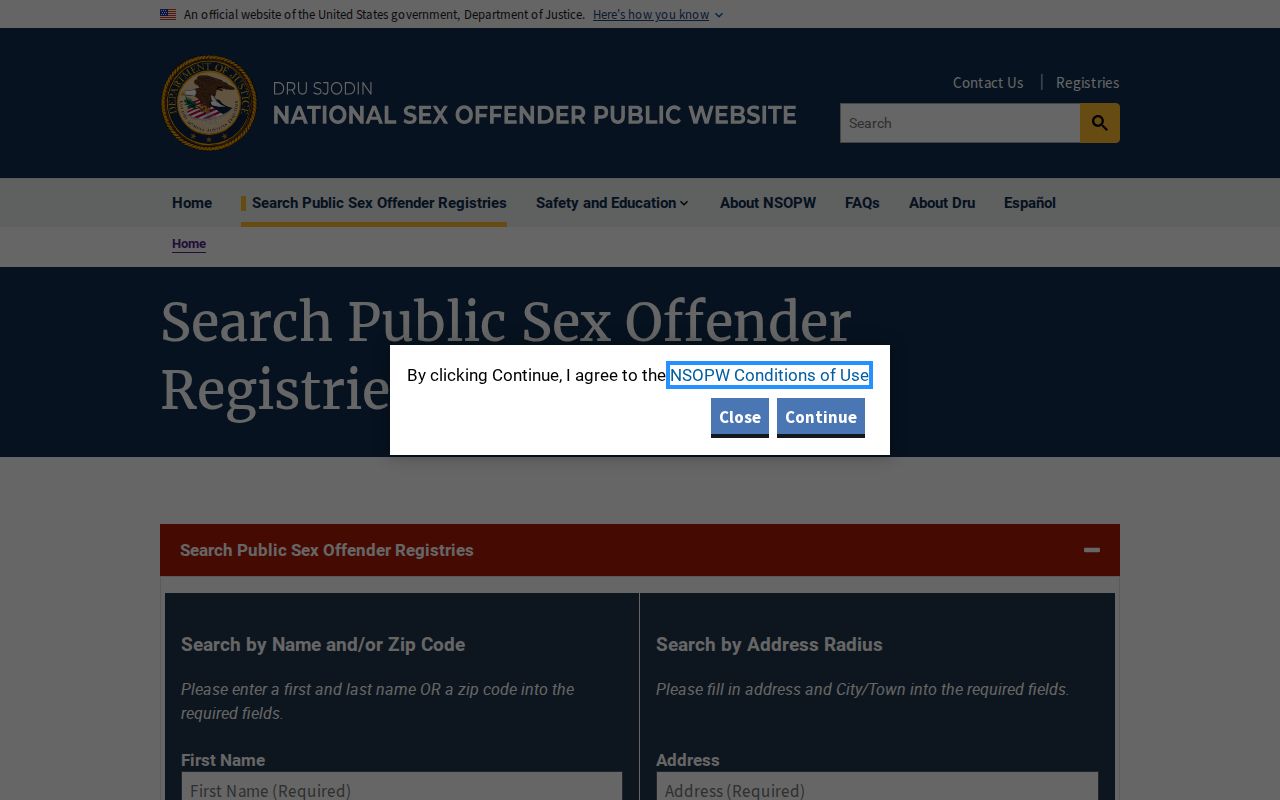
NSOPW inherits each source registry's publication rules and delays. It cannot fill every omission in the Colorado public list. Verify a Colorado result with CBI or the local registration agency, and use the underlying court case for the actual judgment and sentence.
Colorado Registry Requests Beyond Web
The public website is only one Colorado access channel. An adult age 18 or older may request one CBI adult list by ZIP, city, unincorporated county, or the whole state. A statewide list is delivered on compact disc. The signed form asks for identification and contact details, costs $20, and is handled by mail or in person within the stated ten-business-day period.
- A named juvenile request requires a full name and a written need. It has no fee.
- Local police and sheriffs can provide fuller releasable adult information for their jurisdictions.
- The CBI registry office handles state program questions and list forms.
- A narrow CCJRA request goes to the agency that actually keeps the requested record.
The juvenile form can also include a birth date, adjudication county, or case number when known. CBI states a ten-business-day response period and permits mail or email delivery. These request routes do not convert protected data into a public profile, and they do not replace the court file.
Using Colorado Registry Data Lawfully
Colorado registry information supports informed personal, family, and community safety choices. It must be read with the official warnings. Do not equate a public designation with a current risk assessment. Do not republish a profile without its report date and source cautions. If a crime or registration violation is suspected, contact the responsible police department or sheriff. Call emergency services only when danger is immediate.
Harassment, intimidation, threats, vandalism, assault, endangerment, or illegal retaliation can lead to prosecution. C.R.S. §18-9-310.5 also penalizes false statements or unlawful use involving protected juvenile registry information. C.R.S. §18-3-412.5 governs failures to register and related false or incomplete reporting.
Misuse can be a crime. Never use Colorado registry information to threaten, harass, intimidate, endanger, or retaliate against a registrant or family member.
For suspected noncompliance, report the facts to the local registration agency or CBI. Do not attempt an in-person investigation. The official source, local agency, and court file provide the safest path for confirming what a profile means.