
Arrest Records Across Colorado
A Colorado arrest can create four separate records. The arresting city police department, sheriff, Colorado State Patrol, campus agency, or other authorized office writes a Colorado incident or arrest report. A custodial intake creates a Colorado jail booking. Fingerprints can form a CBI arrest cycle. If a prosecutor files charges, a fourth Colorado file begins with the court clerk.
Those Colorado arrest records do not always use the same charge label. A Colorado booking reflects the basis for custody at that moment. The prosecutor may decline, amend, add, or reduce counts. The Colorado court then records the formal outcome. For that reason, Colorado arrest history should be read with the associated court case and not as a stand-alone statement of guilt.
The Colorado Internet Criminal History Check, or ICHC, supplies a name-and-date-of-birth search of public Colorado CHRI reported to CBI. It can include arrests and reported dispositions. It is not fingerprint-verified, and it excludes protected categories such as sealed arrests.
Who Creates Colorado Arrest Records
The office that creates a Colorado arrest record is the first place to request its detail. Colorado municipal police keep city incident files. County sheriffs handle Colorado county enforcement, jail records, warrants, and court security. The Colorado State Patrol keeps reports from its highway enforcement and investigations. CBI maintains its own Colorado investigative records, while federal and tribal agencies use their own channels.
| Agency Type | Colorado Role | Record Channel |
|---|---|---|
| Municipal police | City criminal, traffic, and ordinance enforcement | City police records office or CCJRA route |
| County sheriff | County enforcement, warrants, and jail operation | Sheriff records and jail custody channel |
| Colorado State Patrol | State highway enforcement and CSP investigations | CSP Central Records Unit |
| CBI agents | Complex investigations and agency assistance | CBI CCJRA request route |
| Special police | Campus, transit, or district jurisdiction | The creating agency's records office |
A precise request gives the event date, place, name, report or booking number, and the exact component sought. If an active investigation blocks the full narrative, ask whether a redacted releasable portion is available.
Colorado's Criminal Justice Records Act governs access to these agency records. Records of official action are open, while other criminal-justice material can require a custodian to weigh privacy, safety, an active inquiry, and the public interest. That means the same arrest can yield a short booking entry, a redacted report, or a delayed release depending on the record requested and the status of the case. Direct the request to the creator. CBI cannot release a city police narrative, and a court clerk does not hold a sheriff's booking file.
From Colorado Arrest to Rap Sheet
After a custodial Colorado arrest, the Colorado booking facility captures intake facts, fingerprints, and a photograph. The arresting agency sends fingerprint-supported data to the Colorado Bureau of Investigation. BIRU uses its biometric system to link the event to a Colorado identity and stores Colorado criminal history in CCIC. The Colorado prosecutor and court create later charging and disposition data.
Data flow: Arrest › Booking › Fingerprint Submission › CBI Repository Entry › Court Disposition
A Colorado citation or summons without fingerprints may not create that CBI cycle. Identifier errors can also keep a Colorado court result from matching the arrest. Colorado requires electronic reporting of a final result, but CBI guidance still anticipates unknown or missing dispositions. The Colorado county clerk's official result is the source to resolve such a gap.
Note: Keep the booking, report, TCN, SID, and court case numbers because they help match separate Colorado arrest records.
Colorado Arrest Reporting Gaps
Colorado's statewide arrest history is broad, not flawless. Most Colorado courts began sending electronic dispositions around 1998. Older Colorado events are more likely to lack a matched outcome. Historical audits found large stores of arrest cycles without dispositions. A later Colorado report documented a 96.42 percent match rate for the year ending in May 2020, while a federal FY2024 project targeted 98 percent and identified about 200,000 incomplete pre-1990 histories.
Those dated figures describe system quality at specific points. They do not establish the completeness of one person's current Colorado arrest history. Missing fingerprints, unmatched identifiers, delayed court reports, and unfiled citations remain practical reasons why sources disagree.
A disposition correction updates the stated outcome. It does not seal the record or change the court judgment.
For an older Colorado arrest, CBI may ask for no-file or purged-record letters when no ordinary court disposition exists. The needed proof can come from the arresting agency, municipal court, District Court, or district attorney. Cross-county events may require more than one letter. Search every known name and birth date, then preserve each official response with the repository challenge.
Colorado Arrest Lookup Options
Use a two-track process for Colorado arrest records. Colorado county sources answer the current and local questions. CBI answers the reported statewide-history question. Colorado court records establish what prosecutors filed and how the case ended. Custody tools apply only after determining whether the person is in a Colorado county jail, state prison, or federal system.
- Identify the likely place and arresting agency. Search an official county jail roster or contact the jail for a current booking.
- Use ICHC for the statewide fingerprint-supported Colorado history. Search all known names and review possible multiple matches carefully.
- Browse the directory of all 64 Colorado counties for the proper sheriff, jail, police, and clerk channels.
- Check the Colorado court case lookup for scheduled events, then request the filed counts and outcome from the clerk.
- Use CDOC or federal custody tools only if the person moved beyond the county jail layer.
One search never clears every Colorado jurisdiction. A local arrest can predate a CBI entry, while a statewide history can outlast the local agency's own retention.
Colorado Arrest Statistics Are Aggregate
The CBI Criminal Justice Information Services Unit runs Colorado's UCR and NIBRS crime-reporting program. Monthly summary collection began in 1976. Colorado adopted national incident-based standards in 1994 and received FBI NIBRS certification in 1997. These datasets count reported events and agency activity, not personal arrest histories.
The Colorado Office of Research and Statistics dashboards let users examine crime, arrests and filings, jail, corrections, and supervision measures. Common controls include time, geography, agency, event type, and demographic groups. Reporting coverage and later revisions should travel with any quoted number.
The official ORS dashboard interface visually separates trend analysis from individual arrest lookup.
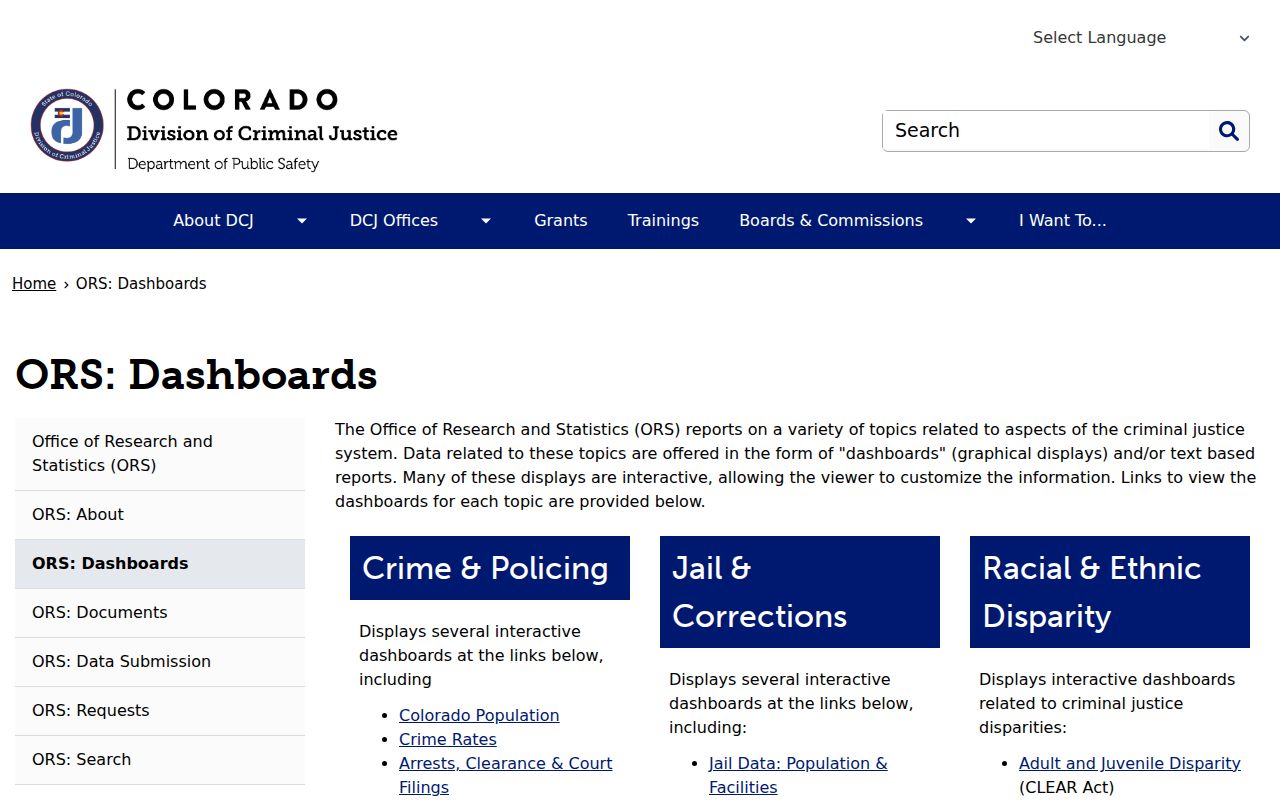
Use it to understand patterns, never to decide whether a named person has a Colorado arrest record.
CBI also describes the official Colorado crime-reporting program and its statewide data role.
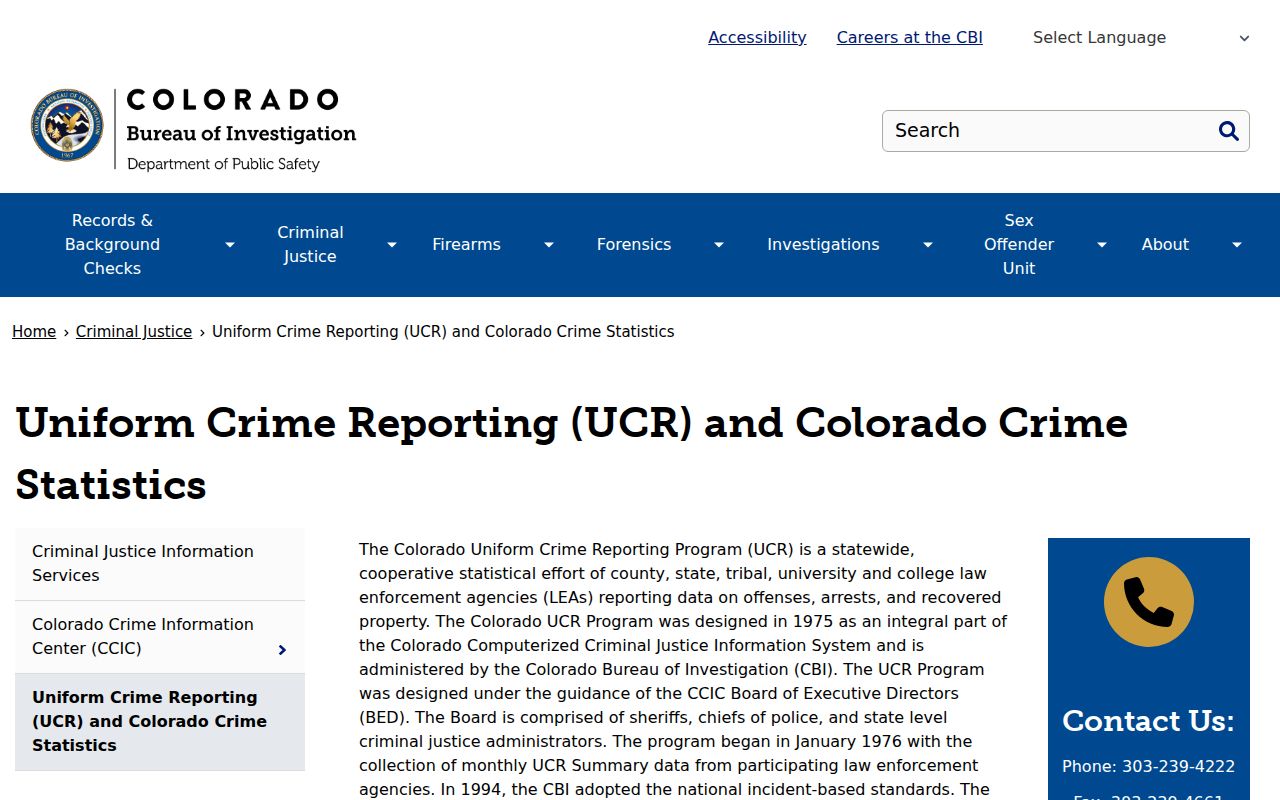
That program receives agency reports but does not expose a name-searchable booking database.
Fields on a Colorado Arrest Record
Fields depend on which Colorado arrest record is open. A Colorado police narrative may describe probable cause, witnesses, property, and officer actions. A Colorado jail booking focuses on intake, custody, and bond. CBI history links a fingerprint-backed Colorado cycle with reported charges and outcomes. Public copies may redact victim details, juvenile information, protected addresses, and sensitive identifiers.
| Name & Identifiers | Names, aliases, date of birth, descriptors, fingerprints, SID, or TCN as permitted. |
|---|---|
| Arrest Details | Date, time, place, arrest number, report number, and arresting agency or ORI. |
| Booking Details | Booking number and time, holding facility, fingerprints, property, and custody entries. |
| Booking Charges | Each initial allegation, statute description, warrant, and related case number. |
| Photograph | Booking image when the custodian finds it releasable under Colorado law. |
| Bond & Release | Bond type or amount, custody status, and release date or method where available. |
Colorado has no single statewide public mugshot gallery. County publication practices vary. Avoid private mugshot sites and confirm the underlying event with the official custodian.
Colorado Arrest Custody Systems Compared
Custody after a Colorado arrest may change. Colorado county jails handle bookings, pretrial detention, and many local sentences. The Colorado Department of Corrections holds people sentenced to state custody and supervises parole. Federal custody uses a separate Bureau of Prisons system. A Colorado county roster cannot answer a later state-prison question.
| System | What It Covers | What It Does Not Cover |
|---|---|---|
| County jail | Recent booking, pretrial custody, local holding, and some sentences | Most state-prison and federal custody |
| CDOC Offender Search | Current and former Colorado corrections jurisdiction | County booking narratives and federal inmates |
| VINELink | Notifications from participating custody systems | A guaranteed live status from every Colorado jail |
| Federal BOP | Federal sentences and custody | Colorado county and state custody |
The official CDOC Offender Search uses a name or DOC number and may show location, conviction offenses, sentence, and release or parole status.
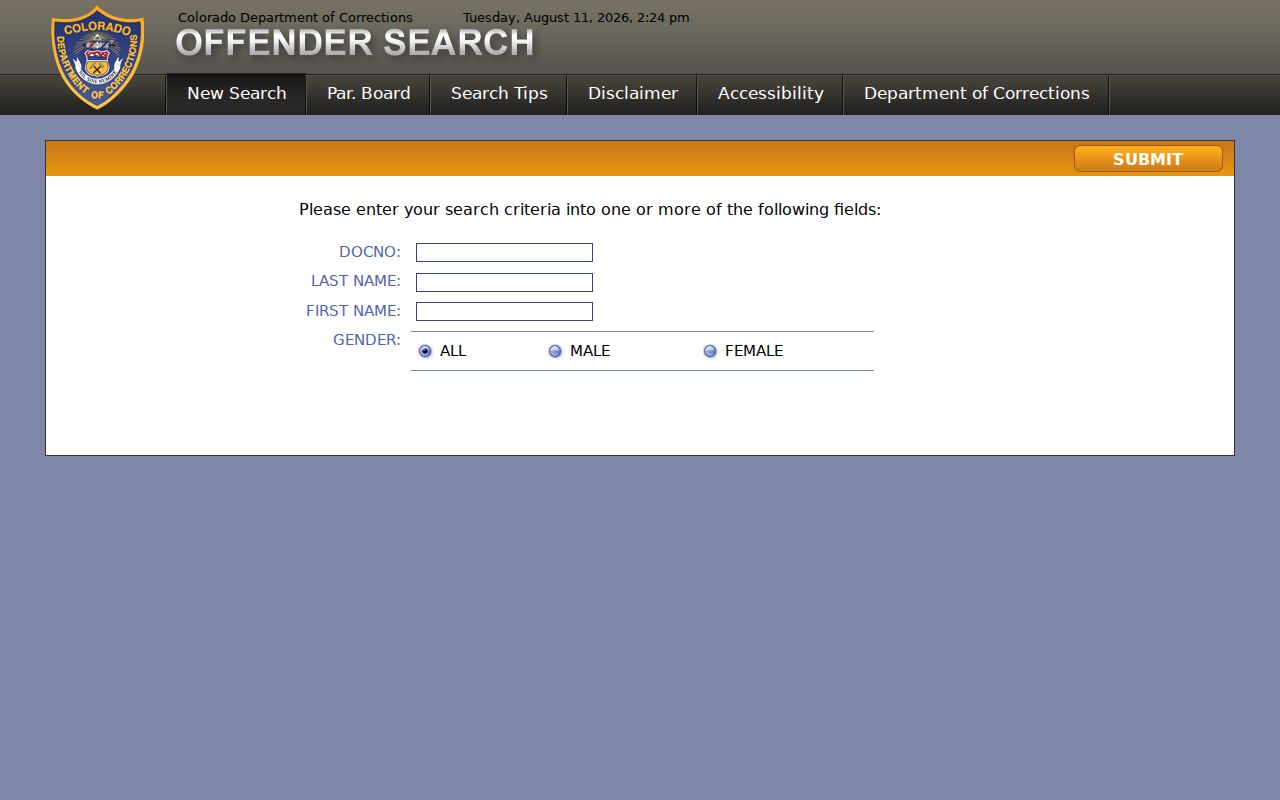
It should not be mistaken for a recent Colorado county booking roster.
VINELink can provide release or transfer notifications when a participating agency supplies the event.
Confirm urgent custody facts directly with the holding agency.
Sealing Colorado Arrest Records
Record sealing is Colorado's usual adult remedy. It restricts eligible records from ordinary public view but does not physically destroy every justice copy. Expungement is narrower and applies to matters such as mistaken-identity arrests and qualifying juvenile records.
For arrests on or after January 1, 2022, Colorado generally provides automatic sealing after one year with no filed charge, subject to exceptions. Dismissals, acquittals, diversion, and eligible completed deferred judgments also have statutory routes. Conviction eligibility depends on the offense, completion, later history, and exclusions.
- Identify every Colorado arrest, court, and custodian tied to the event.
- Use the current Judicial Branch forms and determine whether the matter qualifies for automatic or petition-based relief.
- File in the District, County, or Municipal Court that holds the case or arrest record.
- After entry, confirm the signed order reached CBI and each named custodian.
CBI charges no sealing-processing fee as of July 1, 2024, though court filing and copy charges may remain. If a Colorado arrest entry persists, verify that the court distributed the signed order.
Colorado Arrests and Convictions Compared
An arrest records an accusation and custody event. A conviction is a court judgment after a guilty plea or adjudication. Colorado dissemination can expose both, but the two facts have different sources and meanings. A dismissal, acquittal, no-file decision, or amended charge can make the booking label a poor summary of the final case.
| Arrest Record | Conviction Record | |
|---|---|---|
| Created by | Arresting agency and booking jail | Court judgment, later reported to CBI |
| What it proves | An arrest or booking event occurred | Guilt was established by plea or adjudication |
| Best source | Agency report, jail file, and CBI arrest cycle | County clerk's judgment and certified disposition |
| Public limits | CCJRA balancing, redaction, sealing, and protected categories | Court-access rules, sealing, and protected records |
| Relief | No-charge and nonconviction routes may apply | Narrower eligibility depends on offense and later history |
Note: An arrest entry with no disposition is not proof of guilt; verify the outcome with the Colorado court that heard the case.